
The rise of minimum wage laws: A fight for fair compensation
The concept of minimum wage originated in the 1930s as a response to the Great Depression. The Fair Labor Standards Act of 1938 (FLSA) established the first federal minimum wage, set at $0.25 per hour.
Anúncios
his landmark legislation also instituted a 44-hour work week and protected children from prematurely entering the workforce. Since its inception, the FLSA has been amended multiple times, with the latest federal minimum wage increase occurring in 2009, setting it at $7.25 per hour. The Raise the Wage Act of 2023 now proposes increasing the federal minimum wage to $17 per hour by 2029, a significant step forward in the fight for fair worker compensation.
Over the years, the real value of the federal minimum wage has declined, with a 66-year low in 2023, now worth 30% less than in 2009 and 42% less than its peak in 1968. This erosion of purchasing power has disproportionately impacted vulnerable workers, perpetuating wage inequality and economic disparities, particularly among marginalized communities. The struggle for a living wage continues to be at the forefront of labor rights and social justice movements nationwide.
Historical Origins of Federal Minimum Wage Standards
The roots of federal minimum wage standards in the United States can be traced back to the early 20th century. The National Industrial Recovery Act (NIRA) of 1933, part of President Franklin D. Roosevelt’s New Deal initiatives, was an early attempt to establish fair labor practices, including a minimum wage. However, the Supreme Court later invalidated the NIRA, prompting the Roosevelt administration to craft a more comprehensive solution.
In 1938, the Fair Labor Standards Act (FLSA) was signed into law, marking a significant milestone in the history of federal minimum wage standards. This landmark legislation, championed by Frances Perkins, the first woman to hold a cabinet position as Secretary of Labor, aimed to protect workers’ rights and ensure fair compensation.
Anúncios
The FLSA established the federal minimum wage at 25 cents per hour, equivalent to $5.41 in 2023. Over the years, the minimum wage has steadily increased, reaching $1.00 by 1956 and $7.25 by July 24, 2009. Today, the federal minimum wage remains at $7.25 per hour, though many states have implemented higher minimum wages to better address the needs of their local economies and workforce.
“The passage of the Fair Labor Standards Act was a pivotal moment in the history of worker protection and fair compensation in the United States.”
The Fair Labor Standards Act has undergone numerous amendments and revisions over the decades, expanding coverage and adjusting wage levels to keep pace with economic changes. These efforts have been crucial in ensuring that the federal minimum wage remains a relevant and impactful policy tool for promoting social and economic justice.
| Year | Minimum Wage |
|---|---|
| 1938 | $0.25 |
| 1956 | $1.00 |
| 2009 | $7.25 |
The journey towards establishing federal minimum wage standards has been a long and complex one, shaped by the evolving needs of the workforce, economic conditions, and the ongoing efforts of policymakers, labor unions, and advocacy groups. As the debate around minimum wage continues, the historical origins of this critical policy continue to hold valuable lessons for the future of worker protection and fair compensation in the United States.
The Rise of Minimum Wage Laws: From Great Depression to Modern Era
The federal minimum wage, first introduced in 1938, has been a subject of ongoing debate and evolution. Since its inception, the minimum wage has been increased more than 22 times, with the most recent increase in 2009 setting it at $7.25 per hour. However, the frequency of these increases has declined significantly since the 1980s, leading to a steady erosion of the real value of the minimum wage.
In 1968, the federal minimum wage reached its peak purchasing power, equivalent to $12.50 in 2023 dollars. However, as of 2023, the federal minimum wage of $7.25 has fallen to a 66-year low in real terms, worth 42% less than its highest point in 1968 and 30% less than when it was last raised in 2009. This substantial loss in purchasing power means that the current federal minimum wage is far from a living wage.
The origins of the federal minimum wage can be traced back to the Great Depression, when the Fair Labor Standards Act of 1938 set the minimum hourly wage at 25 cents and the maximum workweek at 44 hours. This legislation aimed to accelerate economic recovery and ensure a decent standard of living for all working people, including adult full-time workers with children. The minimum wage was meant to be a tool for wage increases and inflation adjustment, ensuring that the real value of the minimum wage kept pace with the cost of living.
“The minimum wage was meant to accelerate economic recovery and ensure a decent standard of living for all working people, including adult full-time workers with children.”
Over the decades, the minimum wage has been a subject of intense debate and political maneuvering. While some argue that it has been an essential tool for protecting workers’ rights and promoting economic stability, others have criticized it as a hindrance to job creation and economic growth. As the nation grapples with the ongoing challenges of the modern era, the role of the minimum wage in maintaining purchasing power and ensuring a living wage for all workers remains a critical concern.
Evolution of Worker Protection Policies
The history of worker protection policies in the United States is marked by a gradual expansion of rights and safeguards for employees. The Fair Labor Standards Act (FLSA) of 1938, a landmark legislation, established the first federal minimum wage and maximum workweek standards. However, the FLSA initially exempted several categories of workers, including executives, administrators, professionals, and certain outside sales employees. Agricultural, domestic, and other service-sector employees were also exempted, disproportionately affecting marginalized communities.
Over time, amendments to the FLSA have expanded coverage to more sectors, including agriculture, schools, nursing homes, and restaurants. The 1966 amendments, however, also introduced the tip credit system, allowing employers to pay tipped workers a lower base wage. Today, many exemptions and special provisions continue to affect workers in various industries, highlighting the ongoing evolution of worker protection policies.
Key Milestones in Worker Protection Policies
- The Department of Labor was established in 1913 after a campaign by organized labor, following the progressive movement.
- The Fair Labor Standards Act of 1938 set a minimum wage of 25 cents per hour and a maximum workweek of 40 hours for most manufacturing workers.
- The Wagner-Peyser Act of 1933 revitalized the U.S. Employment Service and established a nationwide system of employment offices.
- The Taft-Hartley Act of 1947 was a response to a wave of strikes after World War II, reconstituting the USCS as the Federal Mediation and Conciliation Service.
The evolution of worker protection policies has had significant economic and social impacts, with ongoing debates surrounding the effects of FLSA amendments, worker exemptions, and the treatment of tipped workers and agricultural workers. As the landscape of labor continues to evolve, policymakers and advocates remain committed to ensuring fair and equitable protections for all workers.
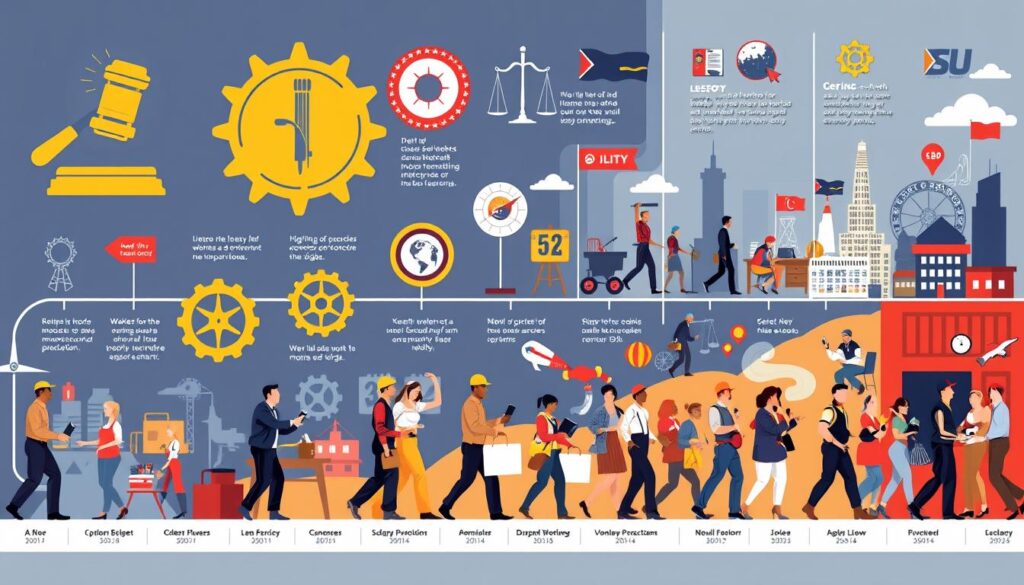
“The historical record shows that after the establishment of a minimum wage in Australia in 1921, unemployment remained a significant issue for unskilled laborers.”
The ongoing debate around the economic impact of minimum wage policies and worker exemptions highlights the complexity of balancing worker protections with potential job losses, especially for marginalized communities. As policymakers and advocates continue to navigate this landscape, the evolution of worker protection policies remains a critical area of focus in shaping the future of the American workforce.
Economic Impact and Wage Value Changes
The failure to adequately adjust the minimum wage for inflation and economic growth has undermined its effectiveness in addressing income inequality. Studies show that Black workers are paid 10-15% less than white workers with the same characteristics, highlighting persistent wage stagnation and disparities.
The real value of the minimum wage has fluctuated over time, with significant declines in purchasing power since its peak in 1968. This stagnation has contributed to widening income gaps and increased economic hardship for low-wage workers.
Under the Raise the Wage Act of 2023, the minimum wage would incrementally increase to $17 per hour by July 2029, potentially lifting some families out of poverty. However, concerns remain about the potential impact on employment, with some studies suggesting job losses for low-wage workers.
| Minimum Wage Statistics | Value |
|---|---|
| Current Federal Minimum Wage | $7.25 per hour |
| Proposed Minimum Wage by 2029 | $17 per hour |
| Subminimum Wage for Tipped Workers | $2.13 per hour |
| Real Value Decline Since 1968 | 39% |
As policymakers grapple with inflation and the cost of living, the debate over the appropriate minimum wage level continues to be a central part of the discussion around addressing income inequality and ensuring a living wage for all workers.
State and Local Minimum Wage Initiatives
As the federal minimum wage remains stagnant at $7.25 per hour, state and local governments across the United States are taking matters into their own hands. In the absence of federal action, a growing number of jurisdictions are enacting minimum wage increases to ensure workers are fairly compensated.
From Alaska to Missouri, lawmakers and voters are driving these initiatives forward. Alaska’s minimum wage is set to rise to $15 an hour by 2027, while Missouri plans to increase its minimum to $15 by January 1, 2026. California has even proposed a statewide minimum wage of $18, reflecting the state’s high cost of living.
These state-level changes are mirrored in local ordinances as well. For instance, the minimum wage in Alameda, California, is currently $17.00 and will increase to $17.35 by 2024 with annual indexing. Belmont, Berkeley, and Cupertino in the same state have also enacted minimum wages ranging from $17.35 to $18.67, with similar annual adjustments.
The trend towards higher state and local minimum wages highlights the growing momentum for wage increases and worker protections in the absence of federal action. As regional variations continue to shape the landscape, the fight for fair compensation shows no signs of slowing down.
“The patchwork of state and local minimum wage laws reflects the urgent need for federal policy to ensure all workers are paid a living wage.”
While the path forward may vary across different jurisdictions, the underlying goal remains the same: to provide workers with the wages they need to thrive in their communities. As these local ordinances continue to evolve, the fight for economic justice shows no signs of slowing down.
Social Justice and Wage Equality
The history of minimum wage laws has been closely intertwined with issues of racial and gender equity. Initial exemptions from the Fair Labor Standards Act (FLSA) disproportionately affected Black workers and women, perpetuating economic disparities. However, the expansion of minimum wage coverage in 1966 had an especially positive impact, nearly doubling the earnings of Black workers compared to their white counterparts.
Despite this progress, maintaining a subminimum wage for tipped workers continues to preserve racial and gender inequities. Women and workers of color are overrepresented in these low-wage jobs, facing a higher risk of worker exploitation and the gender pay gap. Increasing the minimum wage to $15 an hour would meaningfully boost the earnings of 38.1% of Black workers, compared to 23.2% of white workers.
“Low-wage workers often describe the minimum wage as a matter of respect and fairness, not just about the money.”
Minimum wage policies have the potential to address economic disparities and promote racial equity. As President Obama noted, raising the minimum wage is “the defining challenge of our time.” Public support for higher minimum wages transcends income, politics, and racial identity, reflecting a shared belief in the importance of fair compensation and decent work.
However, critics argue that the minimum wage is a “perverse redistributive tool” that reduces efficiency and destroys jobs. They advocate for alternative approaches, such as negative income taxes or transfers funded by general revenues. Nonetheless, the popularity of the minimum wage endures, as an intuitive symbol of a just society that values the dignity of all workers.
The Fight for Living Wages in Modern America
In recent years, grassroots efforts to raise minimum wages have gained significant momentum across the United States. The Fight for $15 movement, for instance, has spearheaded campaigns for higher minimum wages, while ballot initiatives in states like Alaska, Missouri, and Michigan have led to minimum wage increases and additional worker protections. Michigan became the first state in 40 years to adopt a path to “one fair wage” for tipped workers, demonstrating the power of worker-led campaigns in advancing wage policies.
Despite the federal minimum wage remaining stagnant at $7.25 per hour for over a decade, 27 states and various cities have legislated minimum wages surpassing the federal standard. In 2021, however, 20 states still maintained or fell below the federal minimum wage. Notably, only 6 states have a minimum wage of $12.50 or higher, underscoring the ongoing need for sustained efforts to improve the living standards of low-wage workers.
The fight for living wages is particularly crucial in light of the fact that 42% of U.S. workers earn less than $15 per hour, and 39 million workers earned $15 or less per hour in 2019, constituting almost 30% of the workforce. Moreover, the vast majority of minimum wage workers are employed in service industry roles, such as restaurants, grocery stores, hotels, and food preparation, where wages have historically been low.
| Statistic | Value |
|---|---|
| Years since federal minimum wage established (1938) | 84 |
| States with minimum wage surpassing federal $7.25 | 27 |
| States maintaining or below federal minimum wage (2021) | 20 |
| States with $12.50 or higher minimum wage | 6 |
| U.S. workers earning less than $15 per hour | 42% |
| Workers earning $15 or less per hour (2019) | 39 million (30% of workforce) |
The fight for living wages in modern America is a testament to the ongoing struggle for economic justice and the power of worker-led movements. Through ballot initiatives, worker organizing, and sustained advocacy, the Fight for $15 and similar campaigns have demonstrated the potential to drive meaningful change and improve the lives of millions of low-wage workers across the country.
Future Projections and Policy Proposals
As the debate around fair wages continues, policymakers are exploring various proposals to raise the federal minimum wage. The Raise the Wage Act of 2023, for instance, aims to incrementally increase the minimum wage to $17 per hour by 2029, with subsequent indexing to the median hourly wage. This policy change could significantly impact the earnings of low-wage workers, with projections indicating that it would benefit up to 33.5 million Americans by October 2025.
The Congressional Budget Office’s interactive tool allows for the exploration of different minimum wage policy options and their potential impacts on employment, poverty rates, and family incomes. While increasing the minimum wage is expected to raise earnings for most low-wage workers, it could also lead to job losses for others. These trade-offs highlight the complexity of designing effective wage indexing and economic forecasts to support policy simulations that promote meaningful change.
| Metric | Impact of Raising Minimum Wage to $15 by 2025 |
|---|---|
| Workers Affected | 33.5 million |
| Total Annual Wage Boost | $92.5 billion |
| Adults 20+ Impacted | 30.1 million |
| Full-Time Workers Impacted | 19.6 million |
| Women Impacted | 19.5 million |
| Parents Impacted | 9.4 million |
| Single Parents Impacted | 4.6 million |
| Workers in Poverty Impacted | 6.2 million |
As policymakers weigh the potential benefits and drawbacks of minimum wage increases, it’s clear that Raise the Wage Act, wage indexing, economic forecasts, and policy simulations will continue to be central to the ongoing discussions around fair compensation and economic opportunity for all.
“Increasing the minimum wage can have significant positive impacts, but it’s critical to carefully consider the potential trade-offs and design policies that balance the needs of workers and employers.”
The Role of Labor Unions and Advocacy Groups
Labor unions and advocacy groups have played a pivotal role in shaping the evolution of minimum wage laws. While some early labor organizers were cautious about minimum wage legislation, fearing it might undermine collective bargaining, by the 1950s, unions began to actively support and advocate for expanding minimum wage coverage.
Today, labor organizations continue to be at the forefront of the fight for higher wages and better working conditions. They often partner with other advocacy groups to advance worker rights and promote policies that protect the labor movement. These collaborations have been instrumental in driving positive change and generating public awareness around the importance of fair compensation and workplace protections.
| Key Findings on the Impact of Unions |
|---|
|
The data suggests that labor unions and advocacy groups play a crucial role in securing higher wages, better benefits, and stronger worker protections. Their policy advocacy efforts have also had a tangible impact on broader social and political outcomes, such as healthcare coverage, voting rights, and economic inequality. As the labor movement continues to evolve, the influence of these organizations remains vital in the ongoing fight for worker rights and fair compensation.
Conclusion
The rise of minimum wage laws represents an ongoing struggle for wage policy and economic justice. While significant progress has been made since the establishment of the first federal minimum wage in 1938, challenges remain in ensuring that all workers receive a living wage. The future of labor rights and the future of work will likely involve continued debates over appropriate wage levels, coverage expansions, and mechanisms for adjusting wages to keep pace with economic changes.
Numerous studies have shown that minimum wage increases have had little to no effect on employment for low-wage workers, with the median employment response being close to zero. In fact, the majority of studies have found that minimum wage policies have successfully increased pay for these workers. However, the national minimum wage has fallen by 29% in inflation-adjusted terms over the past 15 years, highlighting the need for further action to ensure fair economic justice for all.
As policymakers and advocates continue to push for higher minimum wages, including the Raise the Wage Act of 2021, which aims to raise the federal minimum to $15 by 2025, the impact on workers and the broader economy will be closely watched. With the potential to benefit 32 million workers and generate $107 billion in higher wages, the future of minimum wage policy will undoubtedly shape the trajectory of labor rights and economic outcomes for years to come.
FAQ
When did the concept of minimum wage originate?
What was the first federal minimum wage in the United States?
FAQ
When did the concept of minimum wage originate?
The concept of minimum wage originated in the 1930s as a response to the Great Depression.
What was the first federal minimum wage in the United States?
The Fair Labor Standards Act of 1938 established the first federal minimum wage, set at
FAQ
When did the concept of minimum wage originate?
The concept of minimum wage originated in the 1930s as a response to the Great Depression.
What was the first federal minimum wage in the United States?
The Fair Labor Standards Act of 1938 established the first federal minimum wage, set at $0.25 per hour.
How has the federal minimum wage changed over time?
The federal minimum wage has been increased multiple times since its inception, with the latest federal minimum wage increase occurring in 2009, setting it at $7.25 per hour. The Raise the Wage Act of 2023 proposes increasing the federal minimum wage to $17 per hour by 2029.
What was the role of the Roosevelt administration and Frances Perkins in establishing the federal minimum wage?
The National Industrial Recovery Act (NIRA) of 1933 was an early attempt to establish fair labor practices, including a minimum wage. After the Supreme Court invalidated the NIRA, the Roosevelt administration crafted the Fair Labor Standards Act to protect workers while aligning with the Constitution. Frances Perkins, the first woman to hold a cabinet position as Secretary of Labor, played a crucial role in proposing the law.
How has the real value of the minimum wage changed over time?
The real value of the minimum wage peaked in 1968 at $12.50 in 2023 dollars. As of 2023, the federal minimum wage of $7.25 has reached a 66-year low in real terms, worth 42% less than its highest point in 1968 and 30% less than when it was last raised in 2009.
How have minimum wage laws affected racial and gender equity?
Initial exemptions from the FLSA disproportionately affected Black workers and women. The expansion of minimum wage coverage in 1966 had an especially positive impact on Black workers, nearly double that of white workers. However, maintaining a lower subminimum wage for tipped workers continues to preserve racial and gender inequities, as women and workers of color are overrepresented in these jobs.
What role have worker-led movements played in advancing minimum wage policies?
Recent years have seen significant grassroots efforts to raise minimum wages, including the Fight for $15 movement. Ballot initiatives in states like Alaska, Missouri, and Michigan have led to minimum wage increases and additional worker protections.
What is the potential impact of the Raise the Wage Act of 2023?
The Raise the Wage Act of 2023 proposes increasing the federal minimum wage to $17 per hour by 2029, with subsequent indexing to the median hourly wage. Projections suggest that increasing the minimum wage would raise earnings for most low-wage workers but could also lead to job losses for others.
How have labor unions and advocacy groups influenced minimum wage laws?
Labor unions and advocacy groups have played a crucial role in the evolution of minimum wage laws. Initially, some labor organizers were cautious about minimum wage legislation, but by the 1950s, unions began to support and advocate for expanding minimum wage coverage. Today, labor organizations continue to push for higher wages and better working conditions, often partnering with other advocacy groups to advance worker rights.
.25 per hour.
How has the federal minimum wage changed over time?
The federal minimum wage has been increased multiple times since its inception, with the latest federal minimum wage increase occurring in 2009, setting it at .25 per hour. The Raise the Wage Act of 2023 proposes increasing the federal minimum wage to per hour by 2029.
What was the role of the Roosevelt administration and Frances Perkins in establishing the federal minimum wage?
The National Industrial Recovery Act (NIRA) of 1933 was an early attempt to establish fair labor practices, including a minimum wage. After the Supreme Court invalidated the NIRA, the Roosevelt administration crafted the Fair Labor Standards Act to protect workers while aligning with the Constitution. Frances Perkins, the first woman to hold a cabinet position as Secretary of Labor, played a crucial role in proposing the law.
How has the real value of the minimum wage changed over time?
The real value of the minimum wage peaked in 1968 at .50 in 2023 dollars. As of 2023, the federal minimum wage of .25 has reached a 66-year low in real terms, worth 42% less than its highest point in 1968 and 30% less than when it was last raised in 2009.
How have minimum wage laws affected racial and gender equity?
Initial exemptions from the FLSA disproportionately affected Black workers and women. The expansion of minimum wage coverage in 1966 had an especially positive impact on Black workers, nearly double that of white workers. However, maintaining a lower subminimum wage for tipped workers continues to preserve racial and gender inequities, as women and workers of color are overrepresented in these jobs.
What role have worker-led movements played in advancing minimum wage policies?
Recent years have seen significant grassroots efforts to raise minimum wages, including the Fight for movement. Ballot initiatives in states like Alaska, Missouri, and Michigan have led to minimum wage increases and additional worker protections.
What is the potential impact of the Raise the Wage Act of 2023?
The Raise the Wage Act of 2023 proposes increasing the federal minimum wage to per hour by 2029, with subsequent indexing to the median hourly wage. Projections suggest that increasing the minimum wage would raise earnings for most low-wage workers but could also lead to job losses for others.
How have labor unions and advocacy groups influenced minimum wage laws?
Labor unions and advocacy groups have played a crucial role in the evolution of minimum wage laws. Initially, some labor organizers were cautious about minimum wage legislation, but by the 1950s, unions began to support and advocate for expanding minimum wage coverage. Today, labor organizations continue to push for higher wages and better working conditions, often partnering with other advocacy groups to advance worker rights.
