
Onde encontrar vagas em distritos escolares além de funções de professor
School District Jobs Beyond Classroom Teaching Roles represent one of the largest and most overlooked employment sectors in public education today.
Anúncios
Across the United States, public school systems operate like mid-sized municipal enterprises that require IT specialists, logistics coordinators, behavioral therapists, financial auditors, and facility engineers to function every single day.
According to recent staffing analyses from the U.S. Bureau of Labor Statistics, instructional staff account for barely half of all employees working inside local public education agencies.
Millions of stable, pension-backed careers sit quietly inside district administration buildings, maintenance depots, and student support centers. If you want public-sector benefits without grading papers at midnight, where should you actually look?
Discovering these hidden career tracks requires looking past standard teacher recruitment fairs and generic corporate job boards. In this article, you will explore:
Anúncios
- The dedicated K-12 recruitment portals and state clearinghouses that list non-instructional vacancies first.
- Direct municipal district hiring systems, civil service merit boards, and classified staff portals.
- Specialized professional networks for school operations, clinical student services, and educational technology.
- A side-by-side comparison of top platforms, target roles, and application timelines across the country.
- Practical answers to common questions regarding credentials, union protections, and year-round hiring cycles.
Which Specialized K-12 Job Boards List Non-Teaching District Vacancies?

How Do National Education Portals Filter Administrative and Support Roles?
National K-12 recruitment platforms serve as the primary digital storefront for thousands of public school systems across North America.
Platforms like SchoolSpring, EdJoin, and K12JobSpot allow job seekers to bypass classroom listings entirely by filtering specifically for classified, administrative, or operational categories.
You can narrow your search by selecting departments such as food services, transportation, human resources, or information technology within seconds.
Many rural and suburban districts lack the marketing budgets to advertise on expensive commercial sites, making these niche portals their exclusive hiring hub.
Setting automated email alerts on these platforms ensures you receive immediate notifications the moment a district posts an urgent vacancy.
Creating a thorough profile on these national aggregators saves dozens of hours during peak hiring seasons.
Unlike standard corporate boards where you upload a simple PDF resume, K-12 portals use standardized digital forms that route directly into district applicant tracking systems.
Applicants can attach professional licenses, trade certifications, and letters of recommendation once and reuse them across multiple neighboring school systems.
Because school HR teams rely heavily on keyword filters inside these databases, mirroring the exact terminology from the job description dramatically boosts your visibility.
Think of these portals as the central railway station of public education hiring, connecting every specialized branch to a single departure board.
Why Should You Monitor State Department of Education Clearinghouses?
Every state maintains an official education workforce portal or regional service agency board that aggregates public school openings statewide.
Systems such as PaReap in Pennsylvania, TeachIowa in Iowa, and the Texas Association of School Boards career portal list thousands of operational roles alongside instructional openings.
State-run boards offer verified listings directly from public employers, completely eliminating the risk of expired ghost jobs or third-party staffing markups.
Furthermore, regional education service centers often called BOCES in New York or ESCs in Texas hire hundreds of shared specialists who serve multiple districts simultaneously.
These regional agencies frequently recruit occupational therapists, network administrators, grant writers, and payroll specialists under unified state benefit plans.
Monitoring state clearinghouses also reveals critical funding trends that drive sudden hiring surges across local communities.
When a state legislature approves new infrastructure bonds or mental health grants, regional portals reflect those newly funded positions weeks before commercial aggregators pick them up.
For example, a mid-career network engineer in Ohio who monitored the regional Educational Service Center board secured a senior cybersecurity role before the position ever appeared on national search engines.
Reviewing state portals every Tuesday and Thursday morning puts you ahead of passive applicants who rely solely on mainstream job apps. Consistent tracking turns public funding announcements into actionable career leads.
++ Como empregos sazonais no varejo podem levar a empregos permanentes no futuro
What Role Do Municipal Civil Service Boards Play in District Hiring?
In major metropolitan areas and several northeastern states, non-teaching school employees fall under municipal civil service regulations rather than independent district hiring rules.
Cities like New York, Chicago, Boston, and Los Angeles require candidates for custodial, clerical, accounting, and facilities management roles to pass standardized civil service examinations.
Once you pass the exam, the municipal commission places your name on an official ranked eligibility list used by the school district to fill vacancies.
Understanding this legal framework prevents wasted effort, because submitting a traditional resume without an active exam score will automatically disqualify your application.
Checking your city or county Department of Human Resources website reveals upcoming exam filing windows for School District Jobs Beyond Classroom Teaching Roles.
Civil service pathways offer unmatched job security and transparent promotional ladders once you enter the system.
Every salary step, overtime rule, and longevity bonus is codified in public municipal schedules rather than left to arbitrary manager discretion.
Take the example of an administrative assistant in New Jersey who took the county civil service clerical exam, started in a high school attendance office, and promoted into a district procurement officer role within four years.
Candidates should download the annual civil service exam calendar early and subscribe to municipal testing bulletins.
Preparing for these structured assessments unlocks stable career tracks that rarely appear on private-sector job boards.
How Can You Access Direct School District Career Portals Effectively?
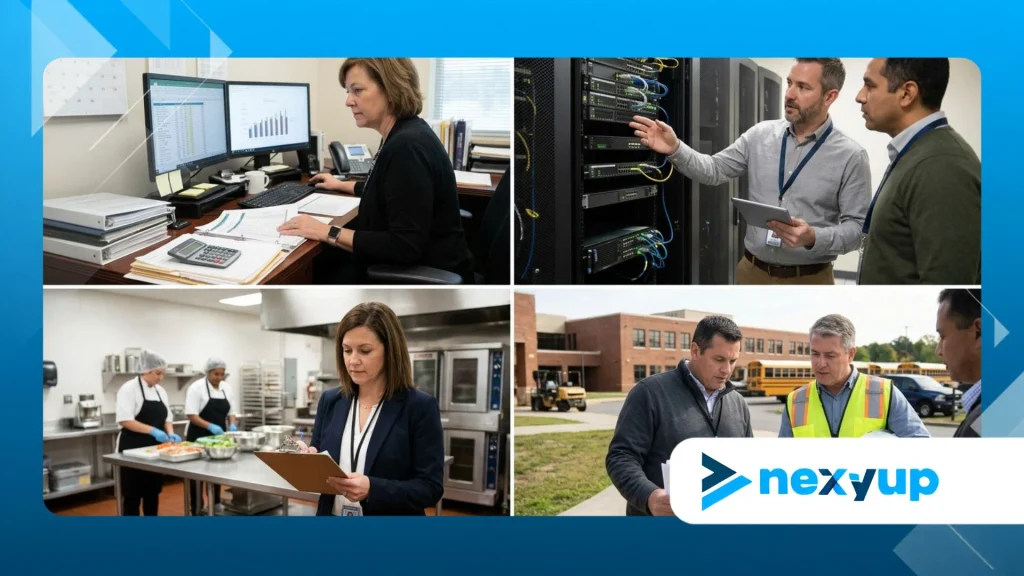
Where Do Local Districts Post Classified and Operational Openings First?
The most reliable source for School District Jobs Beyond Classroom Teaching Roles is always the direct Human Resources webpage of your local school board.
Almost every public school system runs dedicated recruitment software such as Frontline Recruiting & Hiring, PeopleAdmin, or Munis ERP on its official domain.
Districts legally must post internal and external vacancies on their own portals first to satisfy union collective bargaining agreements and public transparency laws.
Navigating to the “Employment” or “Join Our Team” tab on a district website reveals separate application tracks for certified educators versus classified support staff.
Bookmarking the career pages of the five to ten school districts within your commuting radius gives you immediate access to fresh postings.
Exploring direct district portals also exposes specialized roles that general job seekers never realize exist inside public schools.
You will regularly find openings for HVAC technicians, graphic designers, community liaisons, fleet mechanics, purchasing agents, and database administrators.
Districts organize these roles into clear bargaining units, allowing you to inspect the exact salary schedule and health insurance tier before you even apply.
Because HR departments review direct portal submissions before checking external job boards, applying directly at the source places your file at the top of the digital stack.
++ Como a mobilidade na carreira cria mais oportunidades de emprego
How Do Substitute and Part-Time Pools Lead to Full-Time District Careers?
Entering a school district through its substitute or temporary classified pool acts as an informal working interview for permanent salaried roles.
Most districts maintain continuous year-round postings for substitute paraprofessionals, clerical floaters, substitute bus drivers, and temporary IT support technicians.
Accepting short-term assignments lets you build direct relationships with building principals, department directors, and district HR coordinators.
When a full-time position opens in the central office or school front desk, hiring managers overwhelmingly favor reliable internal substitutes who already understand district software and safety protocols.
Stepping into a substitute pool removes the biggest barrier external candidates face: proving you can thrive inside a public school environment.
Transitioning from flexible support work to a permanent salaried contract happens faster than most outsiders expect.
Districts constantly face mid-year retirements and internal promotions that leave urgent gaps in their administrative and operational teams.
Working even two days a week as a classified floater grants you access to internal job postings that are restricted from the general public during the initial posting window.
You also gain firsthand insight into which school buildings and central departments offer the strongest leadership and workplace culture.
Treating every temporary shift with professional diligence turns a part-time foot in the door into a permanent pension-eligible appointment.
Leia também: Por que as vagas de emprego globais estão aumentando a concorrência?
Why Are School Board Meeting Agendas a Goldmine for Job Hunters?
Public school boards publish their monthly meeting agendas and personnel packets online days before their scheduled public sessions.
Reading the “Personnel Report” and “Finance and Operations” sections of these public PDFs gives you extraordinary advance intelligence on upcoming School District Jobs Beyond Classroom Teaching Roles.
When a board votes to approve a new federal grant, a campus construction project, or a district-wide software migration, new staff positions inevitably follow within thirty to sixty days.
You can spot newly created job descriptions in the board packet weeks before Human Resources formats them for the public career portal.
This public-record strategy gives proactive applicants time to tailor their resumes and earn required certifications ahead of the crowd.
Board agendas also reveal organizational restructuring and leadership changes that create sudden lateral openings.
If a district approves the creation of a new Student Wellness Department or expands its special education transportation fleet, multiple support roles will soon open simultaneously.
Reviewing the minutes of your local board takes less than twenty minutes per month and requires zero insider connections.
Simply search your district website for “BoardDocs” or “Board Agendas” to browse recent personnel actions and budget approvals.
Leveraging public governance documents transforms you from a reactive applicant into an informed strategic candidate.
Where Do Industry-Specific Networks Advertise School Operations and Support Roles?
Which Professional Associations Host Niche School Operations Job Boards?
Professional associations dedicated to K-12 business and operations operate high-value job boards tailored exclusively to non-teaching specialists.
Organizations such as the Association of School Business Officials International (ASBO), the Consortium for School Networking (CoSN), and the School Nutrition Association (SNA) maintain active career centers.
School districts turn to these specialized associations when they need credentialed finance directors, chief technology officers, food service managers, and facilities planners.
Unlike broad job sites flooded with unqualified clicks, association boards attract vetted professionals who understand public-sector compliance and fund accounting.
Browsing state-level chapters of these associations uncovers regional leadership openings that rarely appear on mainstream commercial websites.
Membership in these organizations often includes access to mentorship networks, salary surveys, and annual regional conferences where districts conduct on-site interviews.
Even non-members can usually browse active job listings and view detailed competency frameworks for school operations careers.
Studying these listings clarifies exactly which certifications such as Certified Administrator of School Finance and Operations command top compensation tiers.
Aligning your job search with established K-12 trade groups positions you directly in front of superintendents and chief operating officers.
How Do Clinical and Student Support Networks Recruit District Specialists?
Public school districts employ massive teams of licensed clinicians and student advocates who never lead a traditional classroom.
National organizations such as the National Association of School Psychologists (NASP), the American Speech-Language-Hearing Association (ASHA), and the School Social Work Association of America (SSWAA) run dedicated K-12 career portals.
Districts post thousands of direct-hire vacancies on these platforms for speech-language pathologists, occupational therapists, behavioral analysts, and school nurses.
Hiring directly through a school district rather than through a third-party staffing agency typically provides superior pension contributions, predictable school-year calendars, and direct supervision.
Clinical professionals can filter listings by student caseload caps, supervision availability, and rural loan-forgiveness eligibility.
Beyond clinical associations, state school board associations also aggregate student wellness and family engagement roles across all member districts.
Positions such as McKinney-Vento homeless liaisons, bilingual family coordinators, and restorative justice specialists frequently appear on these state-level hubs.
Candidates with backgrounds in social work, public health, or nonprofit community outreach find strong alignment with these student-centered district roles.
Checking clinical and advocacy career centers ensures you capture direct-hire district contracts rather than lower-benefit contractor arrangements.
How Can LinkedIn and LinkedIn Alumni Searches Uncover Hidden District Roles?
Strategic networking on LinkedIn uncovers unadvertised openings and provides warm introductions inside district central offices.
Instead of searching generic job titles, use LinkedIn’s school and company pages to locate your target school district and click the “People” tab.
You can filter current employees by job function such as Operations, Information Technology, Finance, or Human Resources to see the exact titles your local district uses.
Reaching out to a district’s Facilities Director or IT Manager for a brief informational conversation often alerts you to upcoming vacancies before HR posts them publicly.
Public-sector managers frequently struggle to find corporate professionals who understand how their transferable skills apply to school operations.
Following district superintendents, chief financial officers, and regional education agencies on LinkedIn also keeps real-time hiring news in your feed.
Leaders regularly share direct links to urgent central-office openings alongside commentary on new district initiatives.
Updating your LinkedIn headline to highlight transferable operational skills such as public procurement, fleet logistics, or enterprise cybersecurity helps district recruiters find you during passive candidate searches.
Combining targeted LinkedIn outreach with direct portal applications creates a dual-channel approach that dramatically shortens your job search.
Comparison of Top Platforms for Non-Teaching School District Jobs
| Plataforma/Canal | Primary Role Categories | Geographic Scope | Key Advantage for Applicants | Typical Hiring Timeline |
| Direct District HR Portals (Frontline, PeopleAdmin) | All classified, clerical, IT, custodial, and administrative roles | Local school district | Earliest posting access and transparent union pay scales | 3 to 6 weeks |
| National K-12 Job Boards (EdJoin, SchoolSpring, K12JobSpot) | Paraprofessionals, specialists, technicians, food service, and ops | Nationwide (strongest by state/region) | Single standardized profile applies across multiple districts | 2 to 5 weeks |
| State Education & Regional Service Boards (BOCES, ESCs) | Shared therapists, network engineers, grant writers, auditors | Statewide and multi-district regions | Direct public-sector benefits with multi-campus variety | 4 to 8 weeks |
| Municipal Civil Service Commissions | Custodians, school clerks, accountants, stationary engineers | Major metro areas and select states | Strict merit-based ranking and strong union protections | 2 to 6 months (exam cycle) |
| K-12 Trade & Clinical Associations (ASBO, CoSN, NASP, ASHA) | CFOs, CTOs, school psychologists, SLPs, nutrition directors | National and state chapters | High-level leadership roles and direct-hire clinical contracts | 4 to 8 weeks |
Navigating Your Transition Into Public Education Operations
Successfully landing School District Jobs Beyond Classroom Teaching Roles comes down to searching where public employers actually recruit rather than relying on generic commercial job engines.
By combining direct local district portals, state education clearinghouses, civil service exam boards, and specialized K-12 professional associations, you gain full visibility into the operational backbone of public schools.
Every school system depends on skilled professionals in technology, finance, facilities, wellness, and administration to keep classrooms running smoothly all year long.
Which non-teaching department aligns best with your current professional background, and have you checked your local district’s career portal this week?
Perguntas frequentes
Do I need a teaching license to work for a public school district?
No, you do not need a state teaching license for the vast majority of operational, administrative, technical, and support positions in a school district.
Roles in information technology, accounting, human resources, facilities maintenance, transportation, and food services rely on standard industry certifications, trade licenses, or relevant work experience instead of pedagogical credentials.
Only instructional roles and certain specialized clinical positions, such as school psychologists or speech-language pathologists, require state education department credentials.
Always review the “Minimum Qualifications” section of the district job posting to confirm whether a specialized license or civil service exam applies.
When is the best time of year to apply for non-teaching school district jobs?
While classroom teacher hiring peaks between March and June, non-teaching school district roles open continuously throughout all twelve months of the calendar year.
Major hiring surges still occur in late spring and summer as districts prepare budgets for the new fiscal year starting July 1, particularly for paraprofessionals, bus drivers, and facility technicians.
However, central office positions in finance, IT, human resources, and student support open whenever staff retire, promote, or transition.
Monitoring district portals year-round gives you a major advantage during quieter autumn and winter hiring cycles when applicant competition drops significantly.
Do non-teaching school district employees receive pensions and summer breaks?
Most permanent full-time non-teaching district employees qualify for state public employee retirement pensions, comprehensive health insurance, and paid sick leave, though work calendars vary by role.
Central office staff, IT technicians, and facilities personnel typically work twelve-month year-round schedules with paid vacation days rather than unpaid summer breaks.
Conversely, school-based support roles such as instructional aides, cafeteria staff, and bus drivers usually follow the ten-month academic calendar with optional summer school assignments available for extra income.
Reviewing the bargaining unit contract linked on the district HR page clarifies exact benefit tiers and annual workdays.
How can I translate corporate experience onto a school district job application?
Translating private-sector experience for a school district requires highlighting regulatory compliance, budget stewardship, stakeholder communication, and safety protocols.
Instead of focusing solely on corporate profit margins, emphasize how you managed cross-functional teams, maintained strict data privacy, optimized vendor contracts, or resolved complex operational bottlenecks.
Use the exact terminology found in the district job announcement, because public HR screeners score applications using strict rubric checklists tied to posted qualifications.
Demonstrating reliability, clear documentation habits, and comfort working in a community-facing environment makes corporate candidates stand out immediately.
Are background checks required for all school district positions?
Yes, every employee working for a public school district regardless of whether they work inside a classroom or at an off-site central warehouse must pass comprehensive criminal background checks and fingerprinting prior to starting work.
Most states mandate both state-level criminal history clearance and federal FBI fingerprint screening, alongside child abuse registry clearances where applicable.
Because state processing agencies can take two to four weeks to return clearance results during busy summer months, districts initiate background checks immediately upon extending a conditional offer.
Completing your fingerprinting appointment promptly ensures your official start date stays on schedule.
